
BCBA, BCaBA, and RBT are the three main certifications in Applied Behavior Analysis (ABA), representing three different levels of education, responsibility, and independence: Board Certified Behavior Analyst (BCBA), Board Certified Assistant Behavior Analyst (BCaBA), and Registered Behavior Technician (RBT). Each plays a distinct, important role in ABA treatment, but the differences between them can be confusing.
Through the comprehension of that differentiation in these certificates, whether you are a professional getting career growth or a parent addressing the context of ABA therapy, you can make a more knowledgeable decision based on the facts given. This comprehensive yet straightforward comparison of the ABA roles should act like your compass when navigating the complex terrain of the ABA domain, revealing the different paths and tasks of all these critical roles.
What is BCBA?
A BCaBA (Board Certified Assistant Behavior Analyst) is a mid-tier ABA professional who holds at least a bachelor’s degree and has completed coursework in applied behavior analysis. BCaBAs work under the supervision of a BCBA, handling tasks like collecting data and developing behavior support plans.
What is BCaBA?
A Board Certified Assistant Behavior Analyst (BCaBA) is a knowledgeable professional who must have at least a bachelor’s degree and has successfully duly received core competencies in applied behavior analysis. In addition to, most of them serve under the direction of a BCBA and perform respective tasks like collecting data and developing reports that act as a bridge to the ABA Profession, acting for many others.
What is RBT?
An RBT (Registered Behavior Technician) is the entry-level credential in ABA, requiring only a high school diploma and 40 hours of supervised training. RBTs work directly with clients, implementing the behavioral support plans designed by a BCBA or BCaBA and helping clients build new skills and change behavior.
BCBA vs. BCaBA vs. RBT
Finally, let’s take a deeper look into these certificates and see what specific layers set them apart. Comprehending the characteristics of each type of practitioner can help one gain extensive knowledge about the discipline of behavior analysis.
Differences in Education
The levels of education demanded for each certification, establish the platform followed for different professional careers. Conventionally, a master’s degree is a “must” to hold the title of a BCBA, but a bachelor’s degree is the minimum requirement for BCaBA. Moreover, in this context, RBT certification requires a high school diploma.
👉 BCBA: Demands for a Master’s degree in Psychology, Education, ABA, or a related subject.
👉 BCaBA: Requires a Bachelor’s degree as well in similar majors.
👉 RBT: Must have a high school level education or have equivalent competency.
Coursework:
- BCBA: Should enroll on the approved graduate coursework in the application of behavior analysis.
- BCaBA: It is mandated that the candidate undergoes and passes the undergraduate-level coursework which is deemed as behavior analysis approved.
- RBT: Do 40-hour supervised training and pass the RBT initial competency assessment.
Differences in Experience and Certification Requirements
Besides the classes, practical exposure influences their skill set. For candidates to begin the credentialing process, they have to complete a period of internship under supervised hours and pass a written board exam with the utmost difficulty. BCABA, on the other hand, needs to meet a smaller but equally important work experience requirement. The RBTs meet a set of specified competencies and then are eligible to work with clients directly under the supervision of a BCBA.
BCBA (Board Certified Behavior Analyst)
- After certification, BCBAs typically transition into the supervisory role and supervise the work of BCaBAs and RBTs.
- Having their role, they need to have a deep knowledge of ABA principles, which will help them guide and support less experienced therapists to make them work together well.
- To attain BCBA certification there is extensive supervision that can be from 1,500 to 2,000 hours depending on the nature of the supervision.
BCaBA (Board Certified Assistant Behavior Analyst)
- BCaBA is required to have supervision from a BCBA for the practice and ongoing work. Hence, the RBTs can perform functions beyond their scope of practice knowing that they are still supported by the vast experience of BCBAs.
- The BCaBAs will be required to undertake a minimum of 1,000 hours of supervised practical experience.
RBT (Registered Behavior Technician)
- This oversight is pivotal as the fidelity of ABA Interventions and the safety of the service recipients under their responsibility are ensured.
- Supervision needs to be provided, but it is an extracted part of the role, focused on direct, regular oversight by a BCBA or BCaBA.
- Should comply with the 40-hour certified training program approved by BACB, including RBT Task List (2nd Edition), RBT Code of Conduct, and working under supervision.
Note that all these certifications come from the Behavior Analyst Certification Board (BACB) and involve continuous professional development to maintain.
Differences in Roles and Responsibilities
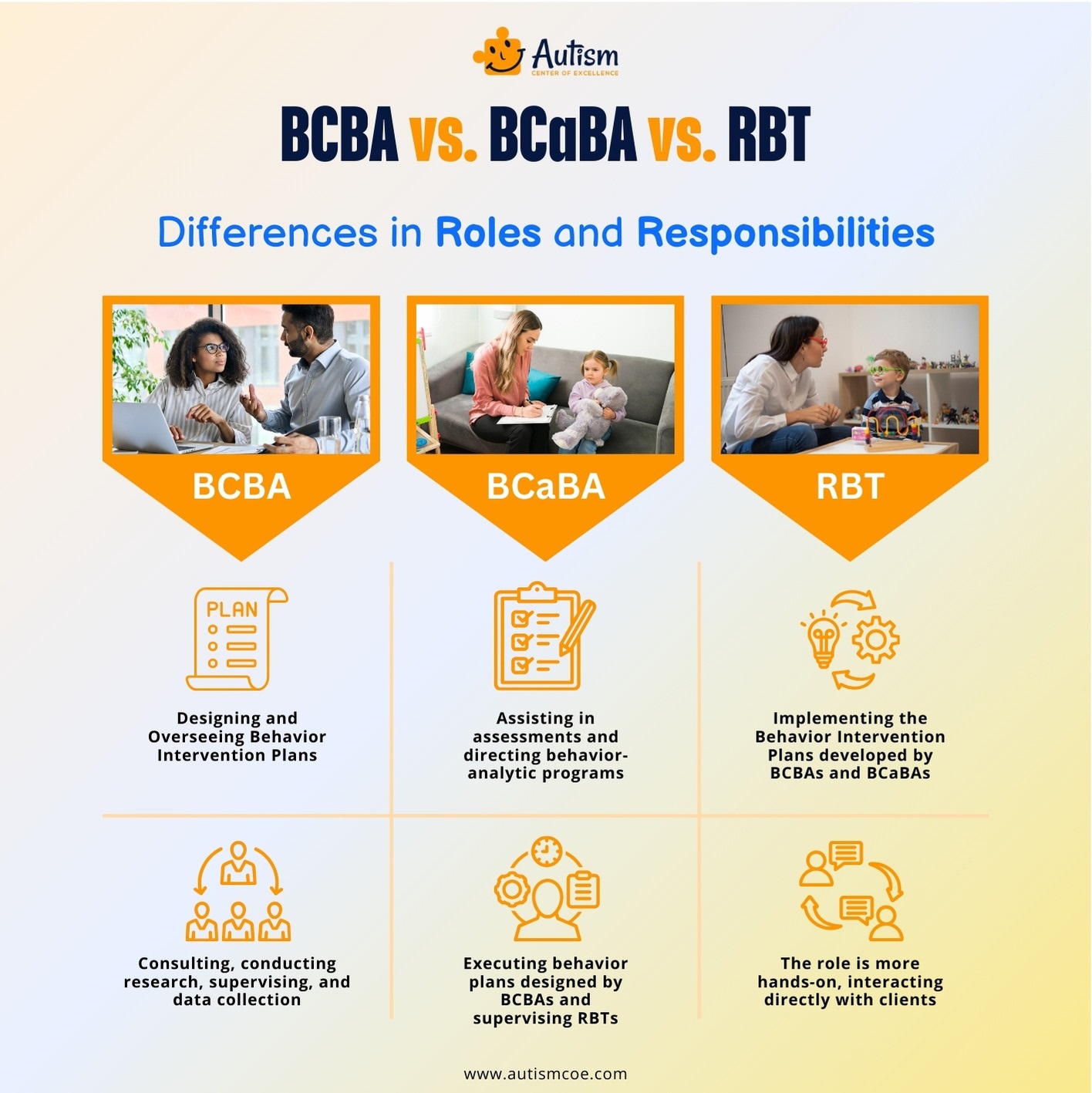
BCBAs are the architects of treatment plans while BCaBAs put into practice what is given. On the contrary, RBTs are the frontline workers in this setup offering direct support and interventions like doing what has been planned by licensed therapists.
Roles:
- BCBA occupies a quintessential position at the front of the hierarchy in Applied Behavior Analysis. They step in to perform as consultants by drafting and implementing Behavior Intervention Plans including goal setting and review process. This sets them apart from the RBTs and BCaBAs who implement these plans.
- BCaBAs carry the approval of the BCBAs. They are an adjunct member of the team, performing evaluations and supervising behavior-analytic programs, while RBTs are concerned with direct services.
- RBTs are the first staff members with clients who undergo the Behavior Intervention Plans designed by BCBAs and BCaBAs. This one possesses a more active component in contrast to the supervisory Role of BCBAs and BCaBAs.
Responsibilities:
- BCBA responsibilities are not limited to the plan implementation: they are also good at the RBTs and BCaBAs supervision, in addition to research development. This position is beyond the therapeutic BCaBA and RBT roles that have more in-charged roles of plan implementation and data collection.
- BCaBAs oversee the behavioral plans written by BCBAs and also aid in the supervisory process of RBTs. This significantly helps the two personnel in splitting the effort more productively between arrangement tasks by the BCBA and therapy session execution by RBTs.
- RBTs work by collecting data on the progress of the clients and reporting it to their RBT or BCaBA supervisors. Such a personal relationship and collection of data is different from that of BCaBA’s and BCBA’s Duties and Role, which more supervises and gives less interaction with the clients.
Differences in Salaries
Compensation is an indication of the tasks and the required qualifications. More likely than not, BCBAs receive the most reasonable salaries of the lot because of their lengthy period of formal training and their supervisory position. BCaABs are paid mid-tier salaries and RBTs work as foundational but have the potential to move up the career ladder.
➡️ In the US, the average salary for a BCBA ranges from $56,000 to $70,000, and some can make up to $75,784 annually. Salary can differ depending on experience, position, qualifications, and other factors.
➡️ Based on the BACB‘s 2022 salary survey, the median salary for BCaBAs registered $50,000. Yet another source holds that the mean earnings for a BCaBA totals approximately $45,000 annually. This may also differ depending on factors like expertise and location.
➡️ The national average salary for an RBT is $44,133 per annum, with some earning as much as $54,000 per annum. For instance, in places like San Jose, California, an RBT can earn an average of $51,058 per annum. On the other hand, the disciplinary range is always very large and some RBTs make as low as $30,000 and as high as $80,000 annually.
Differences in Skills
The applied behavior analysis (ABA) profession requires different and highly developed skill levels for each certification level.
✅ The BCBAs who have achieved the Board Certification are expected to demonstrate an excellent command of many demanding tasks like Behavior analysis, conceptualization of interventions, and complete treatment planning.
✅ Furthermore, Board Certified Assistant Behavior Analysts (BCaBAs) or Registered Behavior Technicians (RBTs) only provide assistance based on behavior intervention plans, primarily sharing the use of ABA Principles elements employed in direct assistance to those in need.
✅ The distinction made between these levels of certification recognizes the varied competencies and proficiencies that an individual has to possess to practice at each of these levels in the field of ABA.
Join Our Weekly Newsletters!
Subscribe now to stay updated with our latest email updates.
Quick Answers to Similar Questions
Understanding jargon is the first step to understanding the profession. Here are quick responses to common queries:
🙋♂️ What is the Difference Between RBT and ABA?
RBT just works directly on service delivery; its case may be an example of the ABA services that include implementation of evaluations and designed interventions. ABA embraces a set of practices from behavior management onwards, e.g. to foster an individual’s development of enhanced nonverbal communication, and interpersonal skills by people with developmental disabilities.
🙋♂️ What is the Difference Between RBT and BCBA?
One of the most important responsibilities of the BCBAs includes using supervisory and evaluative skills to ensure transparency happens throughout the entire system. A RBT is solely responsible for implementing and supervising these programs as directed by the BCBA.
🙋♂️ What is the Difference Between a Behavior Tech and a Behavior Therapist?
While the terms are often used interchangeably, a behavior technician tends to have a formal RBT/BCaBA/BCBA credential, whereas a Behavior Therapist may not have pursued these certifications.
🙋♂️ What is the Difference Between ABA and BCBA?
ABA is the treatment methodology, while BCBA is the practitioner who has eligibility requirements in place and passed the Behavior Analyst Certification Board exam.

Differences in Career Growth Between BCBA, BCaBA, and RBT
With each qualification, one can discover the set of career opportunities that can be completed on the individual’s journey of becoming a therapist in the area of Applied Behavior Analysis (ABA).
⏩ BCBA have a very high probability of finding themselves in managerial positions, thus joining multidisciplinary teams and working on research. BCaBAs’ functions could be also extended to the casual arrangement and the preparation of support plans. RBTs, although entry-level, act as the bedrock for ABA practice, with limitless chances to diversify, grow, and specialize at a very higher level.
⏩ RBTs, BCaBAs, and BCBAs are all in the job market with good perspectives. On the other side, being BCBA credentialed grants you a chance to have better job prospects which also may lead you to work in a more upper position.
⏩ For RBTs looking to advance their careers, becoming a BCaBA or BCBA is a common path. Among different career opportunities, the BCBA career track stands out as a superb chance to make a serious difference in the lives of individuals with developmental disabilities.
Frequently Asked Questions & Answer
Can an RBT Become a BCBA?
Yes. Many BCBAs start out as RBTs, then pursue a bachelor’s and master’s degree along with the required supervised fieldwork hours needed to meet BCBA certification requirements.
How Long Does It Take to Go from RBT to BCaBA?
In most cases of transition from RBT to BCaBA, it usually takes about 2-3 years. This involves attaining a bachelor’s degree (if not already completed), obtaining the required 1000 hours of supervised independent fieldwork, and finally passing the BCaBA exam.
What is the Next Level After RBT?
The typical next step after RBT is BCaBA (Board Certified Assistant Behavior Analyst), followed by BCBA (Board Certified Behavior Analyst) — which requires additional university education and supervised training.
Is Being an RBT worth it?
For many, yes — RBT is one of the most accessible ways to get hands-on experience in ABA without prior certification, and it commonly serves as a stepping stone toward BCaBA or BCBA roles.
Can RBT Practice Without a BCBA?
No. RBTs are required to work under the ongoing supervision of a BCBA or BCaBA, who oversees their work and ensures interventions are carried out correctly.
Can a BCaBA Work Independently Like a BCBA?
No. Unlike a BCBA, a BCaBA must always work under the supervision of a BCBA and cannot independently design or oversee treatment plans without that oversight.
Conclusion
These differences between these credential types not only spell out outstanding educational disparity but also define the choice of specialist subfield within ABA, which is undergoing rapid development and the critical field of health care. Whether as a parent, a stepping stone to a career in this field, or as a professional ABA practitioner, being aware of these uncertainties assists in making an informed decision. Do not forget the point that the certification is not all about the letters after the name but a matter of goal and performance that matter in the lives of the people who need support.
If you are looking for Job Opportunities in a BCBA or RBT, we welcome you to apply to AutismCOE via our Careers Page, as we are actively recruiting for a variety of positions within the ABA field.
Please Note: The content of this blog is for informational purposes only and should not be considered a substitute for professional medical advice, diagnosis, or treatment. Consult a qualified health care professional for personalized guidance tailored to your specific situation.

Esha Bhasin
Esha Bhasin is the award-winning CEO & Founder of Autism Center of Excellence (AutismCOE). She was honored with the 2026 Triangle Business Journal Corporate Leadership Award. Before founding AutismCOE, she spent over nine years as a Senior Consultant at KPMG US. She specialized in Medicaid and State Public Health. Inspired by her own family's autism journey, she founded AutismCOE to improve access to quality autism care. Esha writes about autism care, Medicaid policy, and healthcare operations.