
How to Choose Between Center-Based and In-Home ABA Therapy in Columbia, MD?
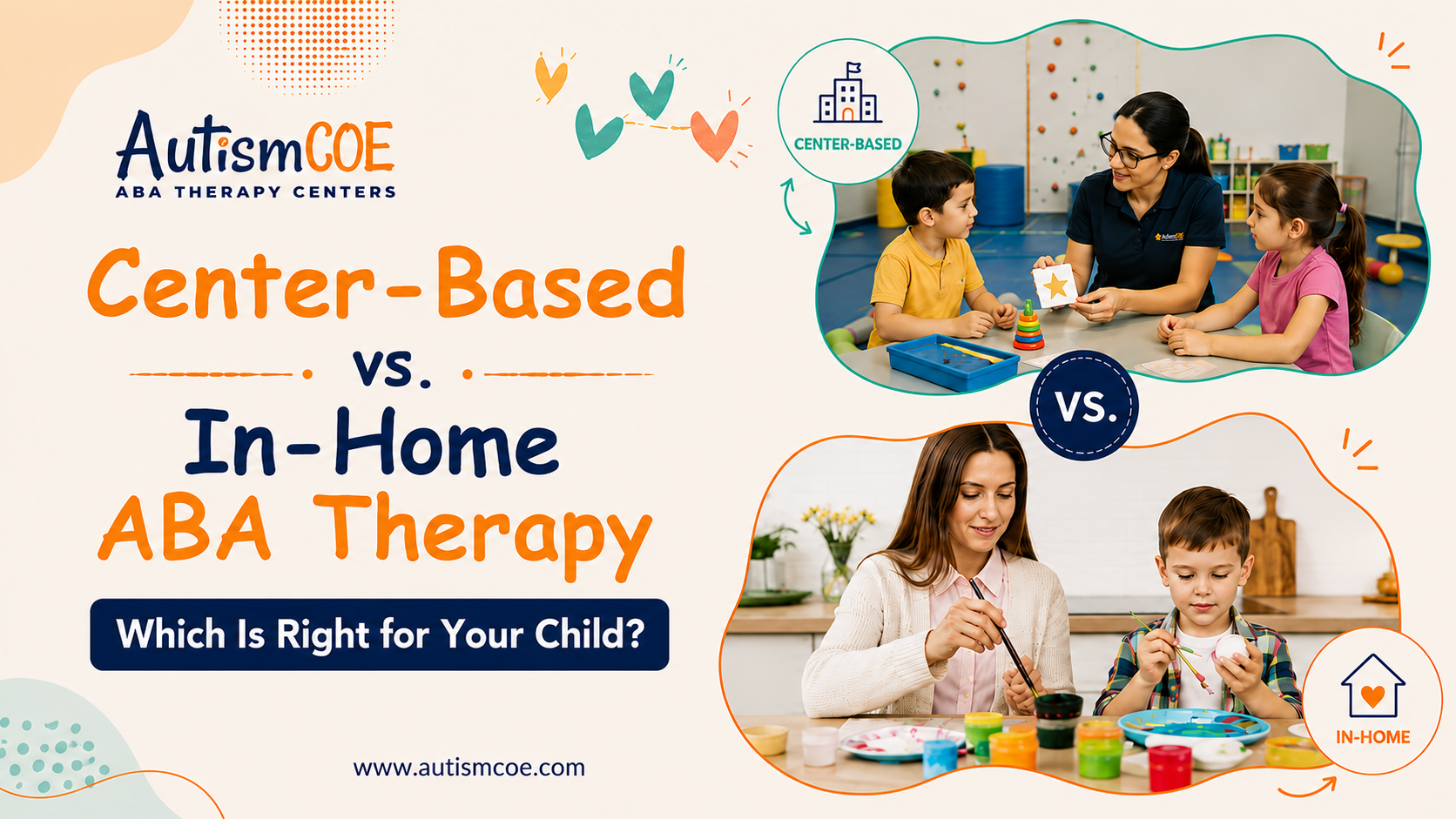
If your child was recently diagnosed with autism spectrum disorder, one big decision is where therapy happens — at home or in a clinic setting?
Short answer: In-home ABA therapy works best for daily living skills and family routines in a familiar setting. Center-based ABA works best for structured learning, peer socialization, and school readiness. Many Columbia, MD families combine both, depending on the child’s age, sensory needs, and goals.
This guide breaks down both settings so you can choose confidently for your family in Howard County.
What Is ABA Therapy?
ABA (Applied Behavior Analysis) is an evidence-based approach using positive reinforcement to build communication, social, and daily living skills while reducing behaviors that interfere with learning.
A Board-Certified Behavior Analyst (BCBA) creates the treatment plan; a Registered Behavior Technician (RBT) delivers daily sessions under their supervision. New to ABA? See our full ABA Therapy overview.

In-Home ABA Therapy: How It Works
In-home ABA therapy takes place in your child’s own house, using their bedroom, kitchen, or living room as the therapy space. The core idea is simple: teach skills in the exact environment where your child will actually use them.
Benefits of In-Home ABA Therapy
- Comfort and lower anxiety. Children often feel calmer and safer in a familiar setting, especially those with sensory sensitivities or significant anxiety around transitions.
- Real-world skill generalization. A child who learns handwashing in their actual bathroom, or mealtime behavior at their own kitchen table, tends to transfer that skill more naturally than one who practices it in a simulated clinic setup.
- Direct family involvement. Parents and siblings can observe sessions firsthand and learn the same reinforcement strategies the therapist uses, which helps keep progress consistent outside of therapy hours.
- No commute. For busy Columbia and Ellicott City families juggling school pickups, work schedules, and other appointments, eliminating drive time can make consistent attendance far easier.
- Individualized pacing. Sessions can be built entirely around your household’s actual routines, whether that’s a difficult bedtime, a specific mealtime struggle, or sibling conflict.
What a Home ABA Session Looks Like
A typical in-home session might include an RBT working with your child on getting dressed independently, practicing turn-taking during a board game with a sibling, or using visual schedules to smooth a transition from playtime to homework. The BCBA periodically joins or reviews session data to adjust goals as your child progresses. Data is collected using an Antecedent-Behavior-Consequence (ABC) framework, which helps the clinical team identify what triggers certain behaviors and what interventions are working.
In-Home ABA Therapy Is Often a Good Fit For
- Younger children, particularly toddlers and preschoolers
- Children with high anxiety around new environments or transitions
- Families prioritizing daily living skills like toileting, dressing, or mealtime behavior
- Children who need extra time to build rapport with a therapist before moving to a group setting

Center-Based ABA Therapy: How It Works
Center-based ABA therapy takes place in a clinic specifically designed for therapeutic learning, with dedicated rooms for different activities. At our Columbia clinic, that includes a gym, sensory room, speech therapy space, and school readiness room, all built to support structured, hands-on learning.
Benefits of Center-Based ABA Therapy
- Fewer distractions. A controlled clinical environment removes many of the everyday interruptions of home life, like siblings, pets, or a ringing doorbell, which can help some children focus more easily during sessions.
- Peer socialization. Children interact with other kids working on similar goals, creating natural opportunities to practice sharing, turn-taking, and group communication that are difficult to recreate one-on-one at home.
- Specialized resources. Sensory rooms, gross motor equipment, and dedicated learning spaces give therapists tools that usually aren’t practical to bring into a family home.
- School readiness. A center environment closely mirrors a classroom, helping children practice sitting for group instruction, following multi-step directions, and transitioning between activities, all of which support a smoother move into preschool or kindergarten.
Immediate BCBA access. Because BCBAs and RBTs work in the same building, clinical oversight and real-time problem-solving tend to happen more frequently.
What a Center-Based Session Looks Like
A center-based day might include one-on-one instruction on early academic skills like matching or tracing, a small social skills group where children practice sharing and initiating play, and structured “circle time” preparation that mimics a classroom routine. Sessions are built around the same individualized treatment plan and data collection process used in-home, just applied within a structured clinical space.
Center-Based ABA Therapy Is Often a Good Fit For
- Children working specifically on peer interaction and social skills
- Kids who benefit from high structure and a distraction-free space to stay engaged
- Children preparing for preschool, kindergarten, or a return to a classroom setting
- Families seeking more intensive, focused skill-building programs
Also Read: How to Prepare Your Child with Autism for Kindergarten?
In-Home vs. Center-Based ABA Therapy: Side-by-Side Comparison
Factor |
In-Home ABA Therapy |
Center-Based ABA Therapy |
| Environment | Familiar, natural setting | Structured, distraction-reduced clinic |
| Skill Generalization | Skills apply immediately to daily routines | May take extra practice to transfer outside the clinic |
| Socialization | Limited peer interaction, more sibling/family focus | Frequent peer interaction and group activities |
| Family Involvement | Parents observe and participate directly, often daily | Parent training scheduled separately from sessions |
| Structure | Flexible, adaptable to household routines | Highly structured, classroom-like |
| Distractions | Possible household interruptions | Minimal, purpose-built space |
| Convenience | No commute required | Requires regular transportation to the clinic |
| Best For | Daily living skills, younger children, high-anxiety kids | Social skills, school readiness, intensive structured learning |
Does Insurance Cover Both Settings in Maryland?
Most major insurance plans cover both in-home and center-based ABA therapy when a child has a formal autism diagnosis, though coverage details can vary by plan. Some policies authorize a different number of weekly hours depending on the setting, and documentation requirements can differ as well.
At AutismCOE, we accept most major insurance providers, including CareFirst BlueCross BlueShield, Aetna, Optum, Priority Partners Medicaid, WellPoint Medicaid, and several others. Our team verifies your specific benefits before enrollment, so you know exactly what to expect and helps you understand coverage for either in-home or center-based services in Columbia.
If your child hasn’t yet received a formal diagnosis, that’s usually the required first step before ABA therapy can begin. Our Autism Diagnostic Evaluations in Columbia are conducted by a Licensed Clinical Psychologist with no waitlist, so families aren’t stuck waiting months before starting care.
How to Decide: A Simple Framework for Parents
Rather than trying to pick a “winner” between the two settings, it helps to walk through a few practical questions with your child’s BCBA.
1. What are the top priorities right now?
If the immediate goal is improving bedtime, mealtime, or toileting routines, in-home therapy often gets there faster because the skill is being taught exactly where it’s used. If the goal is preparing a classroom or building friendships, center-based therapy offers more natural repetition of those specific skills.
2. How does your child respond to new environments?
Some children need the comfort of home to feel regulated enough to learn. Others respond well to the clear structure and predictability of a dedicated therapy space, especially once an initial adjustment period passes.
3. What does your family’s schedule realistically support?
Center-based therapy requires consistent transportation and may involve more total weekly hours. In-home therapy removes the commute but requires a quiet, low-distraction space in your house, at least for part of each session.
4. Is peer interaction a current priority?
If social skill-building is a major goal, center-based therapy provides built-in opportunities that are hard to replicate one-on-one at home.
5. Are you looking for daily coaching, or scheduled parent training?
In-home therapy naturally includes parents in nearly every session. Center-based programs typically offer dedicated parent training sessions instead of daily exposure.
None of these questions has a universally right answer. They’re meant to help you and your child’s BCBA build a plan that fits your specific situation, not to steer you toward one setting over the other.
Can You Combine Both? The Hybrid Approach
Yes, and many Columbia and Howard County families do exactly this. A hybrid approach might involve center-based sessions several days a week for structured learning and social skills, paired with in-home sessions to reinforce those same skills within actual daily routines.
Some children start in-home to build comfort and rapport with their therapist, then transition into a center setting once they’re ready for more structured group learning. Others do the reverse, starting in a highly structured center environment before shifting some hours to the home to work on generalization. Your BCBA can help design this balance and adjust it as your child’s needs evolve, since this decision is rarely permanent.
Getting Started with ABA Therapy in Columbia, MD
AutismCOE offers both center-based and in-home ABA therapy for children ages 18 months to 14 years in Columbia, Ellicott City, Elkridge, and the surrounding Howard County area. Our Columbia, MD clinic includes a gym, sensory room, speech therapy space, and dedicated school readiness room, giving families the option to choose center-based care, in-home sessions, or a combination of both.
Getting started begins with three simple steps: an initial consultation to discuss your concerns, a comprehensive evaluation using respected assessment tools, and a personalized treatment plan built around your child’s specific goals. If your child hasn’t yet been formally evaluated, our licensed clinical team can complete that diagnostic step first, with no waitlist and most major insurance accepted.
Schedule a Free Consultation to talk through which setting, or combination of settings, makes the most sense for your child.
Enjoying Reading?
Join Our Weekly Newsletters!
Subscribe now to stay updated with our latest email updates.
Frequently Asked Questions & Answer
What Is the Difference Between In-Home and Center-Based ABA Therapy?
In-home ABA therapy takes place in a child’s own house, focusing on daily routines and family involvement. Center-based ABA therapy happens in a structured clinic with peer interaction and specialized resources. Both are evidence-based approaches, and many families combine the two for a more complete treatment plan.
Which Setting Is Better for My Child?
It depends on your child’s age, sensory needs, and current therapy goals. In-home therapy tends to work well for younger children and daily living skills, while center-based therapy tends to work well for social skills and school readiness. A BCBA can help match the setting to your child’s individual needs.
Can ABA Therapy Be Done at Home?
Yes. In-home ABA therapy is a widely used, evidence-based delivery model where a Registered Behavior Technician works directly in the family’s home under BCBA supervision, teaching skills in the exact setting where your child will use them daily.
At What Age Is ABA Therapy Most Effective?
Research consistently shows that starting ABA therapy earlier, particularly between ages 2 and 6, tends to lead to stronger outcomes, since early childhood is a critical period for skill development. That said, children of many ages can benefit from ABA therapy, and AutismCOE serves children from 18 months through 14 years.
Does Insurance Cover Both In-Home and Center-Based ABA Therapy in Maryland?
Most major insurance plans cover both settings for children with a formal autism diagnosis, though authorized hours and documentation requirements can vary by plan. AutismCOE verifies your specific benefits before enrollment, so there are no surprises.
Do I Need a Formal Autism Diagnosis Before Starting ABA Therapy?
Yes, a formal diagnosis is typically required to begin ABA therapy and access insurance coverage. AutismCOE offers autism diagnostic evaluations in Columbia with a Licensed Clinical Psychologist and no waitlist, so families can move from evaluation to therapy without long delays.
Can We Switch Between In-Home and Center-Based Therapy Later?
Yes. This decision isn’t permanent. Many children start in one setting and transition to another, or add a hybrid mix, as their needs, tolerance, and goals change over time. Your BCBA will help guide these adjustments.
How Much ABA Therapy Does My Child Need Each Week?
Recommended hours vary widely based on your child’s individualized treatment plan, developmental needs, and insurance authorization. This is determined during the assessment process and reviewed regularly as your child progresses.
Please Note: The content of this blog is for informational purposes only and should not be considered a substitute for professional medical advice, diagnosis, or treatment. Consult a qualified healthcare professional for personalized guidance tailored to your specific situation.

Esha Bhasin
Esha Bhasin is the award-winning CEO & Founder of Autism Center of Excellence (AutismCOE). She was honored with the 2026 Triangle Business Journal Corporate Leadership Award. Before founding AutismCOE, she spent over nine years as a Senior Consultant at KPMG US. She specialized in Medicaid and State Public Health. Inspired by her own family's autism journey, she founded AutismCOE to improve access to quality autism care. Esha writes about autism care, Medicaid policy, and healthcare operations.